

Observe | Think | Explain | Present
Exclusively For Girl Students | Classes VIII–IX
Vigyan Parv 2026 is a national-level online science presentation program designed to encourage young girls to explore, observe, and explain science as experienced in their immediate surroundings.
The program promotes curiosity, scientific thinking, observation, and reasoning, moving beyond rote learning and textbook-based knowledge.
Individual participation only (group entries are not permitted)
PARTICIPATION GUIDELINES
The Theme: SHE – Science from Her Environs
Participants are expected to explore science as observed in their surroundings, such as:
- Home
- School
- Neighbourhood
- Community
- Local environment
- Nature and daily life
The focus should be on:
- Observation and questioning
- Logical reasoning
- Original thinking
- Real-life relevance
- Simple scientific explanations
Rote learning or copying from textbooks/internet is strongly discouraged.
Choosing A Suitable Topic
Participants may select a topic from any one or more of the following broad thematic areas:
- Physics: Motion, energy, sound, light, household physics, transport, etc.
- Chemistry: Food chemistry, water quality, soaps & detergents, corrosion, everyday reactions
- Life Sciences: Health, nutrition, plants, microbes, human body, biodiversity
- Mathematics: Patterns, logic, puzzles, statistics in daily life, real-life problem solving
- Computer Science: Algorithms in daily activities, computational thinking, digital safety, data
- Environmental Science: Waste management, water conservation, climate observations, ecosystems
Interdisciplinary topics are welcome and encouraged.
Developing The Idea
Participants should build their presentation around one central scientific question or observation, supported by:
- Simple research work
- Simple experiments (if applicable)
- Mathematical or logical reasoning
- Data, charts, or observations
- Examples from daily life
The idea should reflect “Science from Her Environs”, not abstract or advanced laboratory research.
Writing An Abstract
An abstract is a short summary of the science presentation. It should clearly explain what was observed, what was studied, and what was learned.
Length of the Abstract –
- Word limit: 150–250 words
- Write in one paragraph (avoid bullet points)
Language –
- Abstract may be written in English or Hindi
- Use simple, clear, and original language
- Avoid copying from textbooks, websites, or AI-generated content
What to Include in the Abstract –
The abstract should briefly cover the following points:
a) Title of the Topic
- Short, clear, and related to daily life or surroundings
b) Observation / Problem Statement
- What was observed in the home, school, or environment?
- What question raised curiousity?
c) Scientific Explanation / Method
- How was the problem studied or understood?
- What was used; observation, a small experiment, data, logic, or comparison?
d) Key Findings / Understanding
- What was learnt from this activity?
- What scientific principle explains the observation?
e) Relevance to Daily Life
- How is this topic useful or important in real life?
What to Avoid –
- Do not write long background theory
- Do not copy content from the internet or books
- Do not include formulas, diagrams, or references
- Do not write conclusions without explaining observations
Writing Style Tips –
- Write in your own words
- Use short and clear sentences
- Focus on “what I observed and understood”
- Keep the explanation age-appropriate and logical
Originality
- The abstract must reflect your own thinking and understanding
- Similar topics are allowed, but content must be original
Submission
- The abstract must be submitted through email until 11.59 pm of 15 May 2026
- Only abstracts following the guidelines will be considered
Preparing The Presentation
- Mode: Online presentation
- Duration: 07 minutes maximum for the presentation
- Language: English or Hindi or Bilingual (a mix of English and Hindi)
- Format:
- PPT / Google Slides (preferred)
- Clear visuals, diagrams, or photographs (if needed)
- Minimal text; more explanation in the participant’s own words
Participants should be prepared to explain, not just read slides.
Online presentations will commence on World Environment Day, 05 June 2026
Practice The Explanation
Participants should:
- Clearly explain why they chose the topic
- Describe what they observed or studied
- Explain how science works behind the phenomenon
- Share what they learned from the activity
Confidence, clarity, and originality are valued more than perfection.
Evaluation Criteria
Presentations will be assessed based on:
- Relevance to the theme SHE
- Originality of idea
- Scientific understanding
- Clarity of explanation
- Observation and reasoning
- Confidence and communication
REGISTRATION
Registration will remain open until 11.59 pm of 31 March 2026.
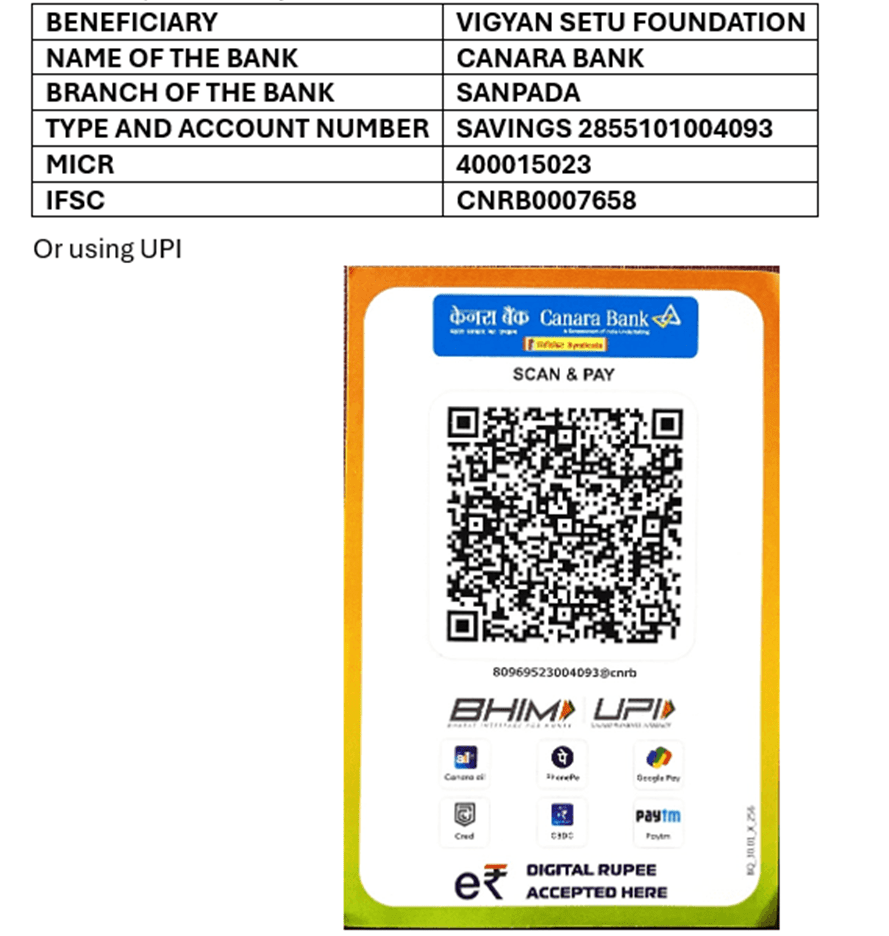
For Registration, YOU will need Personal Details, Tentative Title, and Participation Fee (to be paid through UPI)
Participation Fee: ₹ 499/- (General Category) ₹ 399/- (SC / ST / OBC / underprivileged)
Click on the following link to Register: https://forms.gle/c6CoZnqMyzeQNbni9
