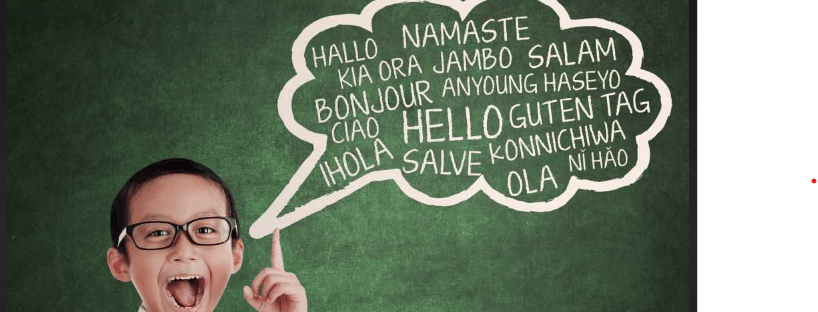
UNESCO’s celebration of International Mother Language Day 2024, on February 21 every year, highlights the importance of implementing multilingual education policies and practices as a pillar to the achievement of Sustainable Development Goal 4 which calls for inclusive, quality education and lifelong learning for all as well as to the objectives of the International Decade on Indigenous Languages (2022 – 2032).
Today, 40% of the world’s population does not have access to education in a language they speak or understand. In some countries this figure rises to over 90%. Yet research shows that the use of learners’ own language(s) in schools provides a solid foundation for learning, boosts self-esteem and critical thinking skills, and opens the door for inter-generational learning, language revitalization, and the preservation of culture and intangible heritage.
Our ‘mother language’, or ‘mother tongue’, is the language we spoke from earliest childhood. For most people, this is just one language but children in multilingual families may learn two simultaneously. UNESCO considers mother languages to be an essential part of culture and identity, and carriers of values and knowledge. They are vital to the preservation and transmission of traditions, expressions, songs, jokes and rituals, which make all our lives richer.
Here are some interesting facts about Languages:
It’s estimated that more than 7,000 different languages are spoken around the world. 90% of these languages are used by less than 100,000 people. Over a million people converse in 150-200 languages and 46 languages have just a single speaker!
Languages are grouped into families that share a common ancestry. For example, English is related to German and Dutch, and they are all part of the Indo-European family of languages. These also include Romance languages, such as French, Spanish and Italian, which come from Latin.
2,200 of the world’s languages can be found in Asia, while Europe has a mere 260.
Nearly every language uses a similar grammatical structure, even though they may not be linked in vocabulary or origin. Communities which are usually isolated from each other because of mountainous geography may have developed multiple languages. Papua New Guinea for instance, boasts no less than 832 different languages!
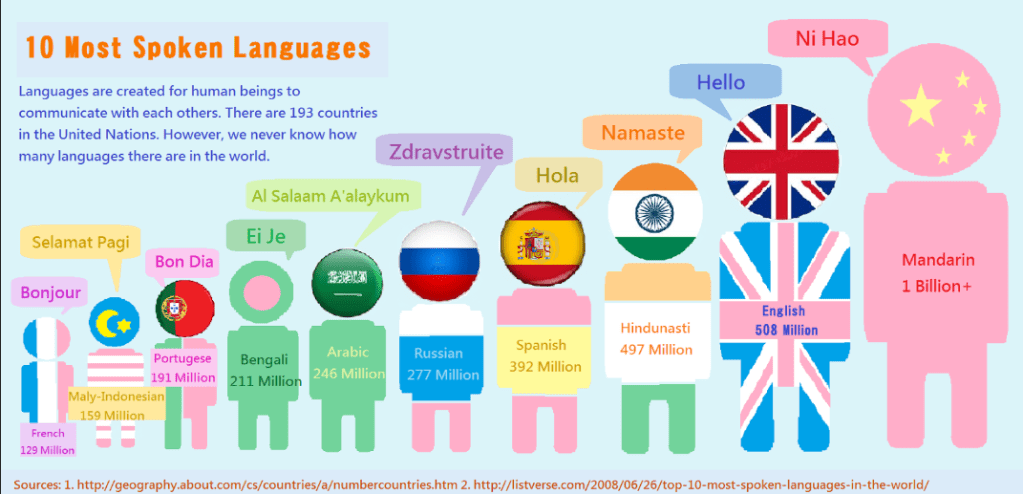
The world’s most widely spoken languages by number of native speakers and as a second language, according to figures from UNESCO (The United Nations’ Educational, Scientific and Cultural Organization), are: Mandarin Chinese, English, Spanish, Hindi, Arabic, Bengali, Russian, Portuguese, Japanese, German and French. The ease or difficulty of learning another language can depend on your mother tongue. In general, the closer the second language is to the learner’s native tongue and culture in terms of vocabulary, sounds or sentence structure, the easier acquisition will be.

So, a Polish speaker will find it easier to learn another Slavic language like Czech than an Asian language such as Japanese, while linguistic similarities mean that a Japanese speaker would find it easier to learn Mandarin Chinese than Polish.
Dutch is said to be the easiest language for native English speakers to pick up, while research shows that for those native English speakers who already know another language, the five most difficult languages to get your head around are Arabic, Cantonese, Mandarin Chinese, Japanese and Korean.
Globalisation and cultural homogenisation mean that many of the world’s languages are in danger of vanishing. UNESCO has identified 2,500 languages which it claims are at risk of extinction.
One quarter of the world’s languages are spoken by fewer than 1,000 people and if these are not passed down to the next generation, they will be gone forever.
The Latin, or Roman, alphabet is the most widely used writing system in the world. Its roots go back to an alphabet used in Phoenicia, in the Eastern Mediterranean, around 1100 BC. This was adapted by the Greeks, whose alphabet was in turn adapted by the Romans.
Here are the world’s most widely-used alphabets (or scripts) which are still in use today (in alphabetical order): Amharic, Arabic, Armenian, Bengali, Burmese, Chinese script, Cyrillic, Devanagari, Georgian, Greek, Hebrew, Japanese script, Khmer, Korean, Lao, Latin, Sinhala, Thai and Tibetan.
Around 200 artificial languages have been created since the 17th century. The first were invented by scholars for communication among philosophers. Later ones were developed by less scholarly men for trade, commerce and international communication. They include ‘Interlingua’ (a mixture of Latin and Romance with Chinese-like sentence structure), ‘Ido’, ‘Tutonish’ (a simplified blend of Anglo-Saxon English and German) and the more commonly-known ‘Esperanto’, invented by Ludwig Zamenhof, a Jewish ophthalmologist from Poland, in 1887.
Esperanto is a spoken and written blend of Latin, English, German and Romance elements and literally means “one who hopes”. Today, Esperanto is widely spoken by approximately 2 million people across the world.
Discover more from Vigyan Setu Foundation
Subscribe to get the latest posts sent to your email.


Ki k open nahi hota hai.
LikeLike