
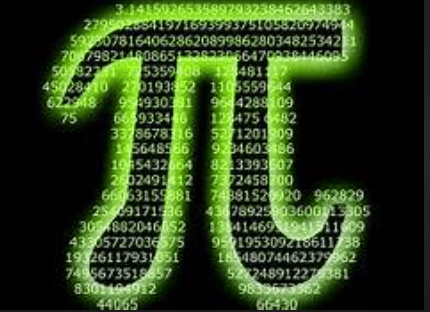
Pi Day is celebrated on March 14th (3/14) around the world. Pi (Greek letter “π”) is the symbol used in mathematics to represent a constant — the ratio of the circumference of a circle to its diameter — which is approximately 3.14159. Pi has been calculated to over 60 trillion digits beyond its decimal point. As an irrational and transcendental number, it will continue infinitely without repetition or pattern. While only a handful of digits are needed for typical calculations, pi’s infinite nature makes it a fun challenge to memorize, and to computationally calculate more and more digits.
On this occasion of World Pi Day, let us have a look into some interesting facts about Pi;
Pi is the most recognized mathematical constant in the world. Scholars often consider Pi the most important and intriguing number in all of mathematics.
The symbol for pi (π) has been used regularly in its mathematical sense only for the past 250 years.
William Jones (1675-1749) introduced the symbol “π” for pi in 1706, and it was later popularized by Leonhard Euler (1707-1783) in 1737.
In the Greek alphabet, π (piwas) is the sixteenth letter. In the English alphabet, p is also the sixteenth letter.
The letter π is the first letter of the Greek word “periphery” and “perimeter.” The symbol π in mathematics represents the ratio of a circle’s circumference to its diameter. In other words, π is the number of times a circle’s diameter will fit around its circumference.
If the circumference of the Earth were calculated using π rounded to only the ninth decimal place, an error of no more than one quarter of an inch in 25,000 miles would result.
A mysterious 2008 crop circle in Britain shows a coded image representing the first 10 digits of pi.
Ludolph van Ceulen (1540-1610) spent most of his life calculating the first 36 digits of pi (which were named the Ludolphine Number). According to legend, these numbers were engraved on his now lost tombstone. Pi is also referred to as the “circular constant,” “Archimedes’ constant,” or “Ludolph’s number.”
Since there are 360 degrees in a circle and pi is intimately connected with the circle, some mathematicians were delighted to discover that the number 360 is at the 359th digit position of pi.
The “squaring the circle” method of understanding pi has fascinated mathematicians because traditionally the circle represents the infinite, immeasurable, and even spiritual world while the square represents the manifest, measurable, and comprehensive world.
Computing pi is a stress test for a computer—a kind of “digital cardiogram.”
The first million decimal places of pi consist of 99,959 zeros, 99,758 1s, 100,026 2s, 100,229 3s, 100,230 4s, 100,359 5s, 99,548 6s, 99,800 7s, 99,985 8s, and 100,106 9s.
Ancient mathematicians tried to compute pi by inscribing polygons with more and more sides that would more closely approach the area of a circle. Archimedes used a 96-sided polygon. Chinese mathematician Liu Hui inscribed a 192-sided polygon and then a 3,072-sided polygon to calculate pi to 3.14159. Tsu Ch’ung and his son inscribed polygons with as many as 24,576 sides to calculate pi (the result had only an 8-millionth of 1% difference from the now accepted value of pi).
There are no occurrences of the sequence 123456 in the first million digits of pi—but of the eight 12345s that do occur, three are followed by another 5. The sequence 012345 occurs twice and, in both cases, it is followed by another 5.
The father of calculus (meaning “pebble used in counting” from calx or “limestone”), Isaac Newton calculated pi to at least 16 decimal places.
In the seventeenth century, pi was freed from the circle and applied also to curves, such as arches and hypocycloids, when it was found that their areas could also be expressed in terms of pi. In the twentieth century, pi has been used in many areas, such as number theory, probability, and chaos theory.
The first six digits of pi (314159) appear in order at least six times among the first 10 million decimal places of pi.
“Pi Day” is celebrated on March 14 (which was chosen because it resembles 3.14). The official celebration begins at 1:59 p.m., to make an appropriate 3.14159 when combined with the date. Albert Einstein was born on Pi Day (3/14/1879) in Ulm Wurttemberg, Germany.
Discover more from Vigyan Setu Foundation
Subscribe to get the latest posts sent to your email.


Those are some really fascinating facts about our favourite irrational number! Here’s one more:
The most decimal places of Pi memorised is 70,000, and was achieved by Rajveer Meena (India) at the VIT University, Vellore, India, on 21 March 2015. Rajveer wore a blindfold throughout the entire recall, which took nearly 10 hours.
Belated Happy World Pi Day!! 🙂
LikeLike